

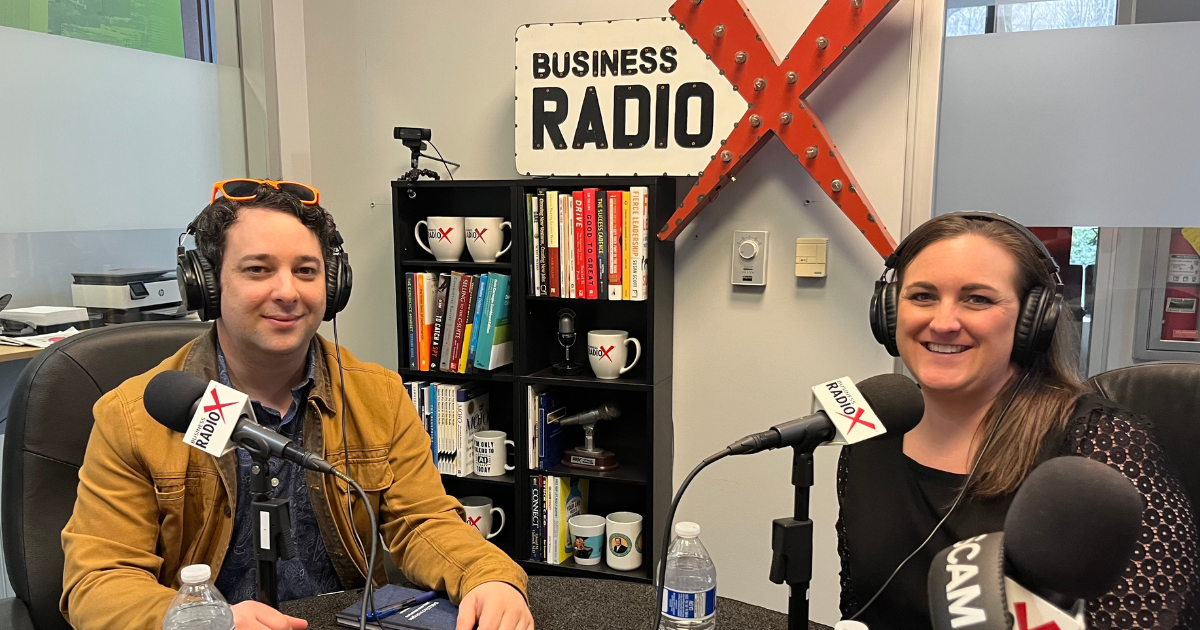
In this episode of Greater Perimeter Business Radio, Lee Kantor and Adam Marx interview Jen Whitlow, Head of Community Partnerships at Fusen World, an early-stage venture fund supporting student-founded startups. Jen shares her journey from Georgia Tech student to startup mentor, highlighting Fusen’s mission—founded by Christopher Klaus—to empower student entrepreneurs. The discussion explores the value of authentic networking, the importance of deep engagement over breadth, and how non-linear career paths can lead to unique opportunities. Jen encourages students and mentors to connect with Fusen and emphasizes the lasting impact of meaningful relationships in entrepreneurship.
 Jennifer Whitlow is dedicated to empowering students, advancing computing education, and fostering the next generation of founders. With more than 14 years of experience designing strategic programs, building partnerships, and creating opportunities for student success, she has made a lasting impact in both higher education and the entrepreneurial ecosystem.
At Georgia Tech’s College of Computing, Jennifer led enrollment and engagement initiatives that expanded access to computing education, redesigned first-year experiences for thousands of students, and established signature programs such as the Klaus Startup Challenge.
She developed and taught courses that introduced students to entrepreneurship and supported them in navigating their academic and professional journeys. Her leadership at Georgia Tech helped increase representation in computing, deepen alumni engagement, and strengthen pathways for students to connect with mentors, funding, and opportunities.
Today, as Head of Community Partnerships at Fusen World, Jennifer works at the intersection of partnership, investment, and education. She leads internationally recognized accelerator programs that extend Fusen’s reach worldwide, and she collaborates closely with Fusen’s investment team to identify high-potential student founders, fosters deal flow from global university and ecosystem partners, and designs programs that strengthen portfolio companies post-investment.
In addition, she coaches Fusen founders as they scale and curates international programming to connect them with resources and mentors, ensuring Fusen remains a trusted partner in the global startup ecosystem.
Jennifer holds an Ed.D. in Leadership and Learning in Organizations from Vanderbilt University, an M.Ed. in Higher Education Administration from Georgia Southern University, and a B.S. in Computational Media from Georgia Tech. Jennifer is a connector, educator, and advocate for students – dedicated to help them thrive, innovate, and lead.
Connect with Jennifer on LinkedIn.
Episode Highlights
- Entrepreneurship and its challenges for student founders
- The role of networking in professional development
- Support systems for student-founded startups and recent graduates
- The mission and background of Fusen, an early-stage venture capital fund
- The importance of maintaining meaningful relationships beyond transactional interactions
- The evolution of networking practices in a post-COVID context
- Strategies for nurturing professional relationships and connections
- The significance of storytelling and vulnerability in entrepreneurship
- Encouragement for students to leverage their communities and seek mentorship opportunities
About Your Host
 Adam Marx is a networking & leadership consultant, speaker, startup advisor, journalist & the founder of The Zero to One Networker.
Formerly the founder & CEO of music-tech startup Glipple, Inc., and as a writer appearing in Crunchbase News, Startup Grind, Mattermark, & others, Adam draws on more than a decade of experiences in the music & startup tech industries to teach others how to cultivate powerful relationships using strategies of patience, consistency, authenticity, & value creation.
As a networking consultant and speaker, Adam has worked with numerous organizations, including Georgia State University, TechStars Atlanta, the Atlanta Tech Village, ATDC (through Georgia Tech), & Startup Showdown, where he’s advised & mentored founders on how to develop magnetic dialogues & long-term relationships.
Adam’s talks include those given at Georgia Tech and Georgia State University, with a keynote at Emory University’s The Hatchery and as a featured speaker for Atlanta Tech Week 2024.
In addition to advising & consulting, Adam sits on the steering committee for InnovATL, cohosts LinkedIn Local ATL, emceed the 2022 Vermont SHRM State Conference, and was a workshop speaker at South by Southwest (SXSW) 2025.
He is currently working on his forthcoming book.
Connect with Adam on LinkedIn and Instagram and follow Zero to One Networker on LinkedIn and Instagram.
 This transcript is machine transcribed by Sonix.
TRANSCRIPT
Intro: [00:00:05] Broadcasting live from the Greater Perimeter. It’s time for Greater Perimeter Business Radio. Now here’s your host.
Lee Kantor: [00:00:18] Lee Kantor here with Adam Marx. Another episode of Greater Perimeter Business Radio. And today’s episode is brought to you by the The Zero to One Networker. Helping founders, funders and operators build the strategic relationships and access that move business forward. For more information, go to 0 to 1 Networker. Adam. Happy new year.
Adam Marx: [00:00:40] Happy new year, Lee.
Lee Kantor: [00:00:42] I know excited to kick off the year. You got a great guest.
Adam Marx: [00:00:45] I do, and I’m going to let her introduce herself right now.
Lee Kantor: [00:00:48] All right.
Jennifer Whitlow: [00:00:49] Awesome. Thanks, Adam. So yeah, I’m Jen Whitlow, I’m head of community partnerships at Fusion Early Stage VC Fund and Accelerator, where we specifically focus on supporting student founded startups or founders who’ve recently graduated from college. And I also come from many years of experience and background in higher ed at Georgia Tech, and still carry a part time lecturer role at Georgia Tech.
Adam Marx: [00:01:19] There’s so much to to break down there. What, you know, let’s just jump right into to fusion and kind of how that came about and what the structure is. And and we’ll start there.
Jennifer Whitlow: [00:01:31] Yeah. So I’ll try to give you the, the high level. So our founder and CEO Christopher Clauss, is a serial entrepreneur and investor here in the Atlanta area. He actually started his first startup internet security systems, in his dorm room at Georgia Tech, as he eventually left Georgia Tech to grow the company. Over the years, he realized that looking backwards on his journey. There were a lot of things that he didn’t have access to as a young student founder, especially in the early 90s when startups weren’t as kind of hip and popular as they are today.
Adam Marx: [00:02:10] You mean pre pre, Shark Tank, Pre-facebook, movie.
Jennifer Whitlow: [00:02:13] Pre Shark Tank, Pre-social media, all of that kind of stuff. And so when his company found success and he was able to get acquired by IBM, he really wanted to find ways to give back to Georgia Tech and to the students. So the first was with a building in his name on campus, and with that, he started spending a lot more time on campus than talking to students and listening to what they were building and kept asking the question, well, you’re building these really interesting projects. Why aren’t you turning them into startups? Like you’re building really interesting things that could be solutions for really large problems. And so he got really involved in how do we help students see entrepreneurship is a real potential pathway post college or even during college. And so he helped get things going with the create program at Georgia Tech. And over the years, as more and more universities reached out to him and different programs decided to, um, launch fusion so that we could support student entrepreneurs on a global scale and beyond kind of the borders of a single university or institution.
Adam Marx: [00:03:28] I you know, I love that because, you know, the the entrepreneurial pursuit is certainly when I was in school, it’s almost a somewhat ambiguous kind of amorphous idea, because so much of it can be in the hard sciences, and some of it can be, uh, very much outside the the Georgia Tech hard sciences laboratories. Um, but I think that this is a really great on ramp to talk about. You know, Chris is a great example of someone, as a Georgia Tech alum coming back and really looking at how he he could have gotten involved and how he did get involved with the academic spaces and and create opportunities for those current students, future students. And I think that that really underscores, underscores very much how important it is to maintain networks post-graduation and to really take advantage of those opportunities when those alumni come back and create opportunities and create conversational avenues for, you know, for for their dialogs.
Jennifer Whitlow: [00:04:38] Yeah. I mean, fun story. I actually met Chris when I was 21 and a student at Georgia Tech. I happened to be one of the students that was helping with the ribbon cutting of his building on campus. And I got to meet him and his family and his co-founders and, uh, friends and stuff. Um, and, you know, never thought I’d be sitting next to him. Yeah. Um, helping launch this, uh, VC fund and build all these new programs to connect with students on a global basis. Um, but over the years after I graduated from Georgia Tech, I went back to work for the university, and I carried on a lot of different roles. Um, kind of looking back, realized they were more entrepreneurial than I ever would have imagined because I was the first in every role I had at Georgia Tech. Um, and shortly after I took on the roles in my own unit. Other units adopted those roles. So it was a very entrepreneurial thing, looking back. Um, but in each of those roles, I had different touch points with Chris, you know, when I was working with first year Dear students and helping with career fair and things like that. We engaged with Chris when he would maybe come back and talk about what it was like to build a company or um, his, uh, startup Kaniva when they were hiring interns, we’d interact with him. Um, but again, never did I think that I would be working with him. Um, and then as I rolled into more alumni engagement roles and working with our advisory boards and things like that, I was interacting with Chris in another way. Um, and then eventually it turned into more of a direct partnership where I was working and helping run entrepreneurship programs for the College of Computing at Georgia Tech. And he was the one that was kind of fueling that momentum. Um, and then, you know, I ended up working for him.
Adam Marx: [00:06:45] I love that because the listeners can’t actually see me smiling at you. Use the word direct, but I think that’s such a wonderful example of how non-linear network building is having touch points with one particular person or organization, and recognizing it could take five, ten, 15, 20 different points in time of interactions and engagements, and continued dialogs that help layer in what eventually becomes a great relationship and an opportunity, in this case, an opportunity to get involved directly in an organization that he was building and a vision that he had for for student entrepreneurs. Um, but, you know, I mean, even even how you and I met is a great example of that. I was introduced to you, I think, at a what was it like a Techstars event or something like that? It was it was.
Jennifer Whitlow: [00:07:43] The many events.
Adam Marx: [00:07:44] One of the many events. Right. And and you know, it was I think it was through, Mike Dicenzo, who we have to get on the show as well. And it was really funny for me because I was introduced to fusion through the lens. Mikey knows that I had a whole history in the music space, and I mean, I don’t know how many people on LinkedIn actually know that’s where I started my my career. Um, so it’s funny, I find myself back behind a microphone, just not with musical artists on the other end. Um, but that’s a really great example of how things happen. And one spark leads to another. And now, you know, now we’re in this space. Um, and I love seeing how fusion has grown since I had that first initial touchpoint.
Jennifer Whitlow: [00:08:31] Yeah. I mean, there are so many relationships I’ve built with peers that I went to school with that are now, you know, we had friendships in college and we used to hang out and then maybe lost touch for a little while post-college. Like everyone.
Adam Marx: [00:08:46] Everyone.
Jennifer Whitlow: [00:08:47] Does. Um, but they went on to either start companies or become VCs. And now that I’m in this role, our relationship is changing from what it was in college. But we’re reconnecting, and now those relationships are coming into play in a very different way. The same with alumni I used to meet at Georgia Tech. There are countless times, and I tell a joke with alumni and others all the time. You’re going to regret telling me, hey, if you ever need anything, let me know, because I am that person that will call you up, um, and take take you up on that offer. But there are countless people that I, countless people that I’ve met over the decades of my time at Georgia Tech as a student. And beyond that, I now will reach out to not for myself, but to connect one of our founders who’s building in an area that maybe I don’t have expertise, but I know someone who does. Um, and so those relationships you never, like you said, you never know how they’re going to come into play. A lot of times it’s not linear at all. Um, and it doesn’t take much to connect with someone in a meaningful capacity and not just in a transactional capacity. Um, and with social media and LinkedIn and all of these tools now, it’s very easy to stay connected to people, even if it’s somewhat passively, so that when you do need to call on that relationship.
Adam Marx: [00:10:14] Yeah, they.
Jennifer Whitlow: [00:10:15] Have that open line of.
Adam Marx: [00:10:16] That person’s there. I mean, I’m glad that that you use the word transactional because I spend so much time really espousing this notion of non-transactional networking. And I think sometimes that gets kind of maybe oversimplified the way a lot of people hear it as, uh, it’s, you know, equating to, okay, don’t, don’t do business, don’t find a business deal here, which is not actually what it is. Business is great. And people should be looking for those Opportunities, but it means that, you know, those opportunities don’t usually present themselves as high. Here I am, and I’d love to give you money for your idea or buy your company or, you know, come work for you or hire you. Right. And so, I mean, you know, you spend a lot of time in, in the Georgia Tech space and, um, you know, what would you tell students or student founders vis a vis like the importance of not just building potential relationships with alumni like Chris, but also recognizing the value of the communities they’re already in at Georgia Tech. And that could be the academic communities. It could be the extracurricular communities. It doesn’t have to be something that is that is, you know, driven towards your major. All those communities are value.
Jennifer Whitlow: [00:11:35] Yeah. I mean, I have this conversation with students all the time, um, in the classroom, the class that I’m teaching right now at Georgia Tech. It’s an entrepreneurial capstone. And so the students are actually building a startup from zero to a fully working, functional prototype at the end of the semester. And I talk all the time about maintaining their connections, leveraging the contacts that they have at Georgia Tech, playing up that student role. You know, one thing I have learned over the years is everyone wants to help the next generation, whether it’s driven by their ego and thinking that they are like, you know, the expert in something or just wanting to give back in some way philanthropically. But with students, they can reach out to people that you know in their heads. It’s like, well, why would that person ever connect with me? Because I’m just a student. What do I have to offer them if I’m not asking them for a job or, you know, mentorship? But the reality is, a lot of times people just like I tell the students all the time, you can reach out to an alum who you think may never want to to reach out or respond to your LinkedIn cold message, but maybe that person hasn’t connected to the university in a while, and they’re wanting to start giving back, and they’re curious about what student life like. Obviously, it looks very different from it.
Adam Marx: [00:13:00] How how do I how do I have an on ramp to get back into a university? Some of the professors I had may have moved on or retired.
Jennifer Whitlow: [00:13:08] Exactly. And so students don’t realize a lot of times I think the value that they bring into a relationship, especially if you’re talking about people who are older than them further along in their professional careers and things like that. But there’s a shared commonality. They have this shared experience, whether it’s their university or a certain class that they took. I mean, there are still some professors at Georgia Tech that I had classes with, um, that are still actively teaching. So there’s like this shared perspective where I can talk to a student and be like, oh, you’re taking that class with that professor. Do they still do this assignment? Do they still do this? And it gives us an opportunity for me to learn what they’re doing now. Um, and to kind of reminisce in a way where, you know, I’m further removed and I see some of the value and stuff from that class that I learned, but it also gives them a chance to share what they’re experiencing and find that commonality with me.
Adam Marx: [00:14:00] I think that there’s there’s a couple of things in this, um, that I think are important to break apart. Uh, the first is that a mindset that I had when I was a student, and I don’t know if it’s a societal thing or. But I think it’s important for students to understand and to hear, you know, if you’re not asking for a job and you just you like what someone’s doing or you like what an alumni is putting together, or it’s motivating to you in some facet, and you send me a message and say, I love what you’re doing. I love this message. I’m actually more inclined to respond to you because you’re not necessarily asking for something. You’re just kind of you’re you’re indicating to me that, like, this gets your motor running. You’re kind of into this idea or this message or you know what the the goal is here. And, you know, I think that it’s very important for students to understand that so much of network building, either during their academic career and certainly post academic career, it’s about maintenance and understanding that, you know, maintaining relationships is hard. Everyone’s got a job and everyone’s got family and things to do. But putting in those habits early on where, you know, maybe you do spend the last couple of weeks of the year and I know I do dropping, you know, happy holiday messages and let’s catch up in the new year. And I’d love to hear what you’re working on. That is how you maintain networks over time. And if you start doing that early and you take it off your plate as something that you have to do and you just do it naturally, that builds really great on ramps long term so that you can maintain these networks that otherwise I think would feel very unwieldy, you know, post-graduation.
Jennifer Whitlow: [00:15:46] Yeah. I mean, I think one of the things you realize as you get older, your circles get smaller because like you said, everyone has all of these competing interests for their time, whether it’s family, career, hobbies, traveling for work, etc.. And so if I’m going to give my time and effort and energy into relationship development, I don’t want to devote that time and energy to someone who’s purely asking me for a job. Or can you write me a referral letter? Or can you connect me to this hiring manager, especially if I don’t have a preexisting relationship with you? If I have an existing relationship with you, that’s an easy low level. Yes, let me refer you. But I also know you. But it’s much easier if someone reaches out to me and says, hey, I have a startup idea and I just need some feedback. I need someone who’s heard 100 something pitches this year to just say, hey, this is interesting. Maybe you should think about going in this direction. Maybe you should look at connecting with, you know, people in this space. Um, that’s where if I’m going to do a 30 minute meeting, I’d much rather someone book a 30 minute meeting and be able to have a real conversation about something that’s mutually interesting and beneficial to both of us, versus just out of the blue. Hey.
Adam Marx: [00:17:10] Hey, hey, I want something.
Jennifer Whitlow: [00:17:12] I want something, um, but it just. And it it’s so easy to build those relationships and maintain them, like I said, somewhat passively. I mean, the reason I’m on the show today is because of one of those holiday messages that you sent at the end of last year. Um, but it can be as simple as just like everyday checking LinkedIn. And when you see someone you’re connected to start a new role like.
Adam Marx: [00:17:38] Yeah, congratulate.
Jennifer Whitlow: [00:17:39] Congratulate them and say, hey, we’d love to hear about this new role. Let’s grab coffee sometime soon or let’s, you know, or it could be even like, I mean, I know a lot of people don’t use Facebook anymore, but it could be as simple as like just logging into Facebook and seeing whose birthday is that day and sending them a quick text message or a message on LinkedIn.
Adam Marx: [00:18:02] So that’s actually something I do is I look at like, who am I actually friends with? And like, can I drop this person a message? And and I will also say that I think that one of the most underrated tactics and I post about this, like consistently is saying thank you and expressing gratitude. It is so stupidly simple to send a follow up message to you or someone else who’s gone out of their way to make an introduction, or even just make a recommendation about potential resources that may be helpful, or someone may find some some traction in and say, wow, you know, this was this was really helpful and I really appreciate you taking time to do this. And that is another touchpoint, because now what you’ve done is you’ve signaled numerous things at one time. You’ve you’ve continued the relationship. You’ve signaled that you recognize someone, took time out of their day to help you. And people who who feel that gratitude, we come away from it feeling like, wow, I’m really incentivized to continue to help this person and to want to see them succeed. So like, I’m I’m keeping a finger on the pulse of of your trajectory. And I’d like to see how I can continue to help you in the future. That’s that scaling and maintenance in building networks that that I think about so often.
Jennifer Whitlow: [00:19:24] Yeah, there are so many times I mean, obviously I’m now I guess almost two generations older than the students that I work with on a daily basis. And so it’s not uncommon for me to attend an event to speak on a panel or something like that. Um, and you’re sitting there, I mean, even in class, some days I’m lecturing and I’m looking at blank stares and I’m like, okay, am I making any sense or am I in, like, a whole nother world? Like, is any of this resonating with students? And so sometimes you leave these events where you feel like you’ve made just very superficial touch points. But then a month down the road, you’ll get an email or a text or a message on LinkedIn saying, I didn’t realize it at the time, but this point you made, or this thing that you said has completely changed my perspective on something or has completely changed my confidence or has allowed me to, you know, explore a new opportunity that everyone else in my circle was saying, don’t do it, don’t do it, don’t do it. That doesn’t make sense. But hearing your story or hearing your perspective gave me the confidence I need to say, hey, this is important to me and this is valuable to me. And there are people who have had this similar experience. There are people who will be there to support my journey. Um, those are the types of messages that keep me going. So even if I leave an event and I’m like, no one listened. I didn’t add any value here. Like every once in a while you’ll get that note.
Adam Marx: [00:21:06] I would also say for for students and people who like, attend attend these kinds of events, I mean, they’re not always students, but certainly in the student entrepreneurial community. Your follow up message doesn’t have to be hyper business. Some of the best follow up messages I’ve had have been like, you know, me sharing a story during a talk or during an event or and, you know, mentioning my history in, in the music world. And I’m a music fanatic and one of the best follow ups I got was, oh, hey, I was at this talk and like, I’m a music person too. Like, what are five albums that like you’re you’re like recommending right now? And I got that when I was like in the grocery store and I couldn’t wait to get home because in my head I’m like, this one, this one, this one, this one, and this is someone who’s appealing to me as a person. Yeah. And there’s something that is so magnetic about, hey, I would love to follow up and start a conversation, but like, we don’t have to start in the business space, you know, if it’s good and it’s organic, it’ll get there.
Jennifer Whitlow: [00:22:09] So many times. The most meaningful messages I get are from female students who say, hearing your story, your professional journey was what I needed to hear because I had so much self-doubt that I was on the right path, or I had so much self doubt that I could combine these multiple areas of interest that I had in this very unique way that people would actually want and resonate with. Like my journey. If you walked through my journey with me from Georgia Tech student to where I am now at every step of the way, I mean, my parents, there were multiple times where they were looking at me like, you’re doing, what are you doing now? Like, what degree are you going back for? What role are you taking on now? Because I started at Georgia Tech wanting to build educational software like educational gaming from a front end perspective.
Adam Marx: [00:23:06] And was that even a thing that like when you were a student.
Jennifer Whitlow: [00:23:09] That was the only way you could do educational technology back then?
Adam Marx: [00:23:13] And I have so many.
Jennifer Whitlow: [00:23:14] Thousand and four with.
Adam Marx: [00:23:15] Technology now at different at Harvard University, at Brandeis University, Emory University. It’s like a it’s a it’s a whole industry.
Jennifer Whitlow: [00:23:21] Now, a lot of it was around. How do you build educational games and interactive educational learning tools? And so like, that’s why I ended up at Georgia Tech. I wanted to be in education. My grandmother was a teacher. My mom worked at the school my entire life growing up. But then both of my grandfathers were engineers. I was the oldest child. I helped my dad on all kinds of, like, projects and, you know, things like that. And so I had a really, like, kind of Stem focus as well. But I loved working with students. And so being a student at Georgia Tech, working on educational gaming allowed me to blend those two. But then I also graduated in oh nine when the economy wasn’t great and there weren’t a lot of jobs. And I was lucky that, you know, through my experiences at Georgia Tech, I had built relationships. I was able to come back and work for the university in a very unique role, with first year computing students not building technology or writing code anymore. But I was helping them understand how what they were going to learn at Georgia Tech and in a computer science degree could translate to so many different industries. And then I went into, you know, teaching. And now I’m in the VC startup world. And it’s it never made sense. But at each step of the way, the decision I made in that moment, that opportunity that presented itself made sense.
Adam Marx: [00:24:44] I think it’s really important. And like maybe I’ll get pushback for saying this, but I’ll be the one to say it. Everyone has a roadmap. It doesn’t matter if your roadmap makes sense to the people around you or not. I’ve spent an enormous amount of my adult life. I studied history and like art history, and what I was doing outside the classroom was like I was effectively running a radio program, and I took it seriously, and I was going to shows, and I started a music company out of school, which which was actually a lot harder than I thought it would be. Um, but I did music journalism, which then led to music tech journalism, which then, you know, I never thought I’d be a journalist. I didn’t study that. Um, and being in technology for me is kind of like a, like a punchline to a joke from ten, 15 years ago because I was never in never a hard science person. I always liked science documentaries, but I could never hold a candle to people who could, like, write computer code. And it was a long time to figure out how do I fit into this? I love entrepreneurship, and there’s got to be a space for like, my skill set, and there’s got to be something that that creates value for other people and other companies. And I think that your your indication of like how your story changed over time based around the landscape and based around different relationships. Again, it’s that non-linear Yeah component, which is critical.
Jennifer Whitlow: [00:26:19] So many times when I made a major pivot in my professional life, it was because someone I had developed a relationship with identified a way that my skill set was so unique, but could bring so much added value to this new opportunity that no one else. It wasn’t traditional, but because it wasn’t traditional, it brought more value than hiring someone that made sense on paper.
Adam Marx: [00:26:50] Being unique is a certain kind of value and you don’t know what the value. It’s a question mark until until someone says, oh, that’s that’s kind of different. I need that.
Jennifer Whitlow: [00:26:59] And it’s usually someone that you’ve built a relationship with that out of the blue pops in to the picture.
Adam Marx: [00:27:06] It’s the relationships. And so many of the stories I tell start that way, where it’s I showed up at an event which led to a conversation which led to this and this and this And I think that particularly students, I mean, I sometimes have given talks and I see that like sometimes the eyes glaze over like, oh, how’s this? How’s this going to actually affect my, my GPA or my, you know, my major or whatever. My, my yeah, my graduation or my grad school application. And those things are absolutely important for someone to have on their priority list. But I think that part of what’s really critical is for students to recognize how this is just a totally different part of the brain that they should recognize. You know, that relationship building is it overlays everything. It overlays your academic career, it overlays your post-academic your professional career. And it’s just running in the background. It’s like a program that’s continuously running in the background that brings opportunities to your doorstep, often when you’re not looking for them.
Jennifer Whitlow: [00:28:10] Yeah, I’ve noticed an interesting trend in not just with students. With professionals. Um. Personal relationships. And I don’t know if it’s a. Because of Covid and having those years where we all felt like we lost out on opportunities, whether it was going to events or seeing people in our lives or travel or whatever. But one thing I’m noticing is like when I was in school, there weren’t as many student organizations. There were still a lot, but there weren’t as many as there are today on a campus. There weren’t as many opportunities throwing themselves at you. But even then, people, it felt like we were more intentional with how we spent our time, even as students. Like, obviously, yes, school was important, but we found 1 or 2 things on campus that we dove into deep and the same. In my early professional career, there were 1 or 2 things that I did outside of family and close friends and my actual like day to day job. But I kept those very focused and intentional. In the last two, three, four years post Covid, what I’ve noticed is everyone commits to everything or signs up to attend everything or wants to go to every networking thing, but then they end up not committing to.
Adam Marx: [00:29:40] Anything, to anything.
Jennifer Whitlow: [00:29:42] And so I keep trying to tell students, and I know it’s different because this is the generation of students where to just stand out for college applications. They had to get involved in a lot of different things to showcase, um, their qualifications. But once you kind of get to college, it’s more about focus and commitment and diving deep on the things that are really important to you. And yes, grades and stuff are important. But if I look back at like, anything that’s. Been a big turning point in my life or any like really detailed memory when I think back to college. It’s outside of the first test grade I got back at Georgia Tech. That was a shocker. None of it has to do with my grades. None of it has to do with my classes I took. It all has to do with like, oh, remember that all nighter camped out at the picnic tables where Papa John’s maybe delivered, like, 20 times in a six hour span? Because everybody in our class was working on this one project for, like, 48 hours straight. Um, those are the memories I have or the connections that I made from some really interesting event that I went and got to meet someone that I never thought I would have met at that time.
Adam Marx: [00:30:58] And someone with whom you end up finding a really kind of unexpected, great kind of vibe. I mean, for me, it’s I can’t underscore how funny it is that I find myself in tech. Um, I think at this point, like, there are people who think I went to Georgia Tech. I did not go to Georgia Tech. I said, when I was at Brandeis, I took Java for like 40 minutes during the grace period and like that was enough. So to fully underscore for people like how much I didn’t go to Georgia Tech and write code, um, but you end up finding yourself in kind of odd but kind of wonderful situations through through not not trying to do everything, but also allowing yourself to be open to things that may not be directed towards your major. You may be doing biomedical engineering and still you love theater. Like there may be something there, and you don’t have to necessarily earn money from something to be in that community and maintain those relationships and connections that the fact that you enjoy it and it brings you something positive and and that you give something positive, that’s enough.
Jennifer Whitlow: [00:32:01] When you need things that are not just professionally driven.
Adam Marx: [00:32:05] Yeah.
Jennifer Whitlow: [00:32:06] I mean, you brought up Broadway. I love Broadway. One thing I do that is like, my thing is I have season tickets to the Fox, so I know almost at least once a month, maybe once every six weeks or so. I have a night out with either my mom or a girlfriend to go see a show one night a month, which it gives me something to look forward to every month. That has nothing to do with showing up to another happy hour, or another pitch competition, or another like professional evening event. But it’s something that I can just go and enjoy and for, you know, four hours, turn my phone on silent, not answer emails, not answer messages, just fully disconnect with the world. Stay connected to one person who I’m attending the event with and just enjoy.
Adam Marx: [00:32:58] And and what a great example of for there. There are lots of students who are into theater. I it was a huge thing at Brandeis. We did a 24 hour musical, which is exactly what it sounds like. You write, cast, score, rehearse, and put on a musical in 24 hours. Even to people who were never into theater, were into it. And what a great thing for other people to recognize aux gens into this. Maybe that’s a point of commonality that you share with some of the students, or with some of the entrepreneurs that isn’t, hey, I want something. It’s just what what Broadway play is just like, top of your list right now. And that’s an that’s a wonderful opening for a conversation to develop.
Jennifer Whitlow: [00:33:40] Yeah, something like that. Um, another thing that I’ve done is like, as I’ve traveled places when I mention, oh, I’m excited to go to city X or country Y, hearing people say, oh, I’ve been there. You’ve got to do this on that trip. And again, it has nothing to do with business, but it’s building that relationship. There’s a commonality. It gives us something to talk about so that when we do need to leverage that business aspect of the relationship and call in a favor or ask for assistance with stuff. We’ve got this underlying relationship where we feel comfortable reaching out, and we know that even if they maybe can’t help us, they’re going to respond and say, you know, I wish I could help you, but I just I have no cycles right now. I, you know, my contact that I would have introduced you to is no longer with that company or in that organization, but it makes almost saying, I’m sorry, I can’t help you even easier.
Adam Marx: [00:34:41] It’s and it makes it, you know, and hearing it, hearing that like, oh, it’s just not the right time.
Jennifer Whitlow: [00:34:46] Yeah.
Adam Marx: [00:34:47] It makes it a little easier because what you’re hearing is not, hey, I don’t want to help you go away. What you’re hearing is, look, I just that person took another job, or I don’t have that same contact, but I may have another contact that comes through my comes through my email list, or I may have something else. Maintaining the relationship, particularly when like it’s not a green light right this second. And calendars are not totally meshed right this second. That’s when it’s the most important for for students and student founders to really understand like poor into that relationship and double down on expressing gratitude and saying, that’s fine. I would love to continue our conversation and if it makes sense at some point, then we’ll have that dialog. At that point, we could talk. We could talk for hours. Um, you know, I will take a moment to express gratitude. Uh, thank you for for coming and joining us today. Is there anything else that you want to to share? I mean, we talked somewhat about fusion. We could talk more about fusion in the future.
Lee Kantor: [00:35:49] Yeah. What do you need more of? How can we help you?
Adam Marx: [00:35:51] Yeah, precisely.
Jennifer Whitlow: [00:35:53] Yeah. Um, I mean, I think for me, if I look at fusion, our whole goal is to connect student founders with opportunities, with mentors, with experts in fields that maybe our team doesn’t have the expertise. And so if, um, you know, always happy to to connect. I’m a Southerner and I can talk to anyone and everyone. Um, so always happy to chat about what we’re doing at fusion, um, and ways people can engage. We also have a lot of really great portfolio companies that maybe have the solutions you need for your company or your organization. So open to.
Lee Kantor: [00:36:36] So you want to connect with students that are in any, uh, for sure, any Georgia college, uh, that are working on something.
Jennifer Whitlow: [00:36:43] Yeah. I mean, we’re happy to connect with students who are building stuff. We’re happy to connect with people who are in their professional careers. And maybe, you know, maybe they need a solution for something that we can help them with. Um, or maybe they want to share their.
Lee Kantor: [00:36:57] Expertise, maybe.
Jennifer Whitlow: [00:36:59] Mentorship experience and expertise and give back to young founders who are trying to figure this out and grow their professional network beyond their peers and their classmates and their university.
Lee Kantor: [00:37:11] And then what’s the website? The best way to connect?
Jennifer Whitlow: [00:37:14] Best way to connect is directly with me on LinkedIn. Um, we do have a about page on our website, Infusionsoft slash about um, and there is a general info at fusion email they can email. But the best way is just to connect directly with me on LinkedIn. Um, and we can go from there.
Adam Marx: [00:37:37] Now, this was this was so much fun.
Jennifer Whitlow: [00:37:40] Yeah. Thanks for having me.
Adam Marx: [00:37:42] Thank you for being here.
Lee Kantor: [00:37:43] All right. This is Lee Kantor for Adam Marx. We will see you all next time on Greater Perimeter Business Radio.














